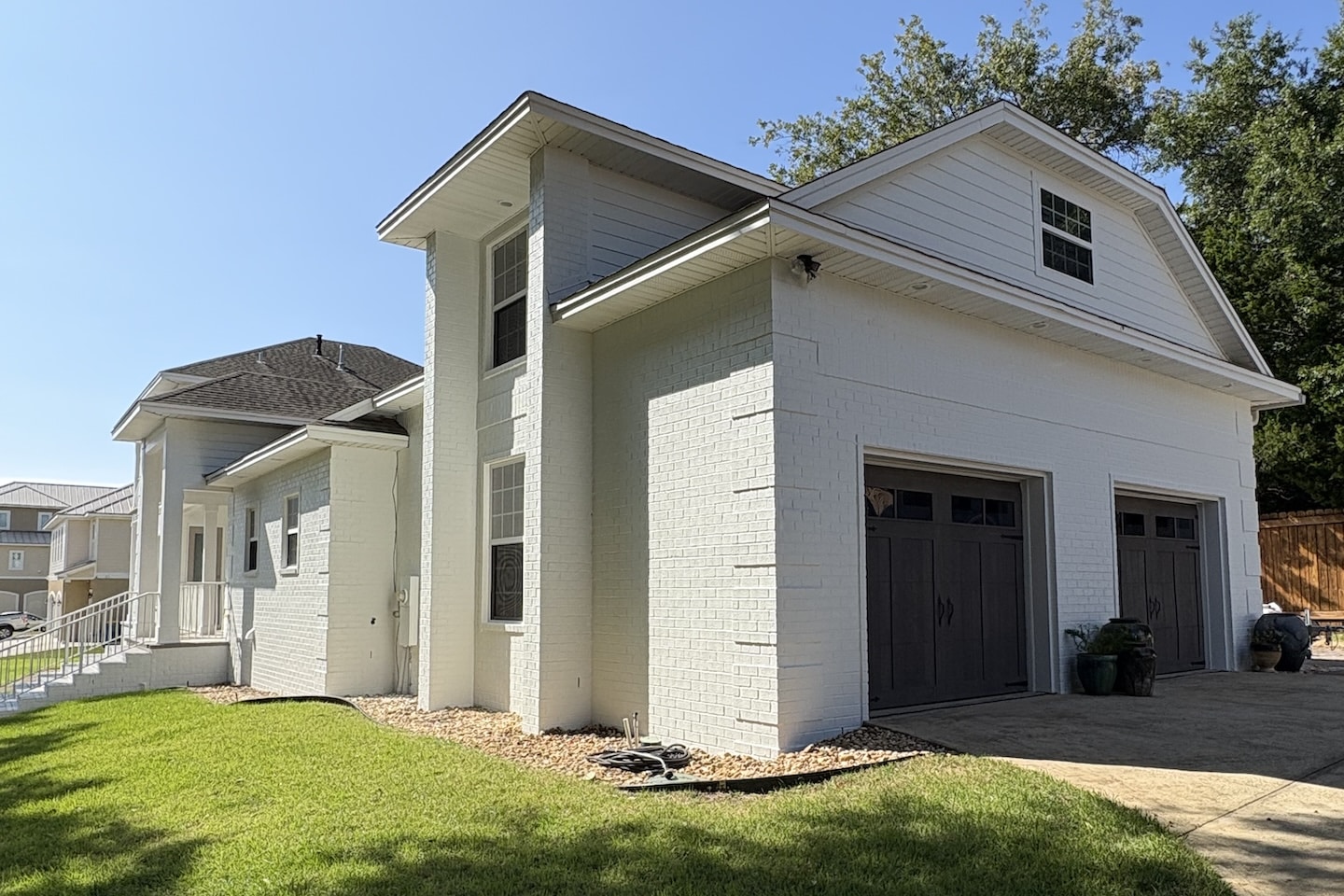
If the paint on your house seems to wear out faster than it did when you lived inland, you are not imagining it. Coastal exterior paint on the Emerald Coast deals with salt, humidity, strong sun and wind-driven rain all at once, and each one attacks the finish in a different way. This guide explains what is actually happening to your siding and trim, how to read the damage you can see, and which preparation and maintenance steps make the biggest difference for homes in Destin, Miramar Beach and along 30A.
Four Forces Working on Your Exterior at Once
Inland, paint mostly fights sun and rain. Near the Gulf, it fights four things that make each other worse: sun weakens the coating, salt and moisture get into the weak spots, and storms push water behind anything that is not sealed.
Salt that you cannot see
Salt rides in on the breeze and settles on every surface as a fine film. You usually cannot see it, but it matters. Sherwin-Williams notes in its guidance on peeling under eaves and porches that salts can form an invisible film that keeps a new coat from bonding to the old one, and that sheltered areas need extra attention because rain never rinses them. On a beach house, that means the underside of a porch ceiling or the wall under a deep overhang can be the dirtiest surface on the house, even if it looks clean.
Moisture from outside and inside
High humidity, heavy dew and frequent rain mean exterior surfaces here rarely stay dry for long. Moisture also moves outward from inside the house. Sherwin-Williams explains that moisture blistering can happen when water travels through a wall and pushes the paint film off from behind, and that the cause has to be found and fixed before repainting. Paint is not a waterproofing system on its own.
Sun and heat
Ultraviolet light slowly breaks down the binder that holds paint together. The result is fading and chalking: a fine white powder that comes off on your hand. Sherwin-Williams describes chalking as normal weathering that becomes a problem when it is heavy, and lists low-grade paint and coatings applied too thin among the causes. South and west walls usually show it first. Heat adds stress too, because siding and trim expand in the afternoon sun and contract in the evening, flexing the paint every day.
Wind-driven rain
During storms, rain does not just fall on a house. It is pushed sideways into seams, corners and gaps around windows and doors. Once water gets behind the paint, the wood or stucco underneath swells and the paint lets go. According to Sherwin-Williams, worn-out or missing caulk in joints, corners and openings is a common cause of exterior peeling due to moisture.
How to Read the Damage on Your Own House
Walking around your home with a clear idea of what each symptom means will tell you more than any general rule. Here is what to look for:
- Powder on your hand when you rub a sunny wall: chalking from UV. The surface needs a thorough wash before any new paint can bond.
- Dark spots on shaded walls, under eaves or behind shrubs: often mildew. A few drops of household bleach is the usual test; if the spot lightens, it is likely mildew rather than dirt.
- Bubbles in the paint: moisture or heat lifting the film. Look for a water source before anything else.
- Peeling at trim, window corners and joints: water getting in where caulk has failed.
- Peeling in protected spots, like porch ceilings: often salt or grime that was never washed off before the last paint job.
- Rust streaks below nail heads, fasteners or railings: salt speeding up corrosion on exposed metal.
- Hairline cracks in stucco: small openings that can let water behind the coating if they are not repaired.
Each of these has a different cause, which is why a good repaint starts with diagnosis, not color.
Why Your Home’s Material Changes the Plan
We paint stucco, siding, brick and trim on coastal homes, and each material behaves differently near the water.
Stucco and masonry
Stucco is durable but porous, and it develops fine cracks as temperatures swing. Cracks need repair, and the coating has to suit a masonry surface. One homeowner who reviewed us mentioned that the advice on the specific paint for their stucco home and exterior doors was what they valued most. That is typical: on the coast, product choice per surface matters.
Wood siding and trim
Wood absorbs moisture, swells and shrinks, which stresses the paint film. Loose paint has to be scraped back to a sound edge, bare wood primed, and any soft or rotted sections repaired before painting. For decks, rails and wood you want to keep natural, a stain may be a better fit than paint; our staining and wood finishing page explains that option.
Fiber cement
Fiber cement generally holds paint well, but factory finishes can build up heavy chalk over time. It still needs a clean surface free of salt, chalk and mildew for new paint to bond.
Metal railings, doors and fixtures
Metal is the most sensitive to salt. Rust has to be removed and the surface primed with a product made for metal before topcoats go on, or the rust comes back through the paint.
What Actually Makes a Coastal Exterior Last
1. Wash first, and wash the sheltered areas too
Every exterior we paint starts with cleaning. Our exterior painting process begins with power washing, sanding and repairs so the new coating has something sound to grip. Salt, chalk and mildew all prevent adhesion, and porch ceilings and soffits need as much attention as the walls that get rained on. If you only need cleaning right now, our power washing service covers that on its own.
2. Treat mildew instead of covering it
Painting over mildew almost guarantees it will come back through the new finish. It needs to be cleaned, rinsed and allowed to dry fully before priming.
3. Seal the openings
Old, cracked caulk around windows, doors, trim and penetrations gets removed and replaced. This is slow, unglamorous work, and it is one of the main things that keeps water out from behind the paint.
4. Prime the right places with the right primer
Bare wood, repaired stucco, metal and stained areas each need an appropriate primer. Sealing and priming is a separate step in our process for a reason.
5. Use a quality exterior coating at the right thickness
Higher-quality acrylic exterior paints resist chalking better than low-grade products, and coatings applied too thin wear out sooner. Two full coats over a properly prepared surface are the common approach.
6. Paint at the right time of day
Painting a wall that is still wet from morning dew, or one baking in direct afternoon sun, can cause adhesion problems and heat blistering. On the coast, that means planning each side of the house around the sun and watching for afternoon storms.
Exposure Changes From House to House
A Gulf-front home takes the most salt spray and wind. A home a mile inland may struggle more with humidity and mildew on shaded sides than with salt. Even on one house, the side facing the water and the side facing the street can wear very differently. That is why we look at each elevation separately before recommending prep or products, whether the home is in Destin, along 30A, or in Miramar Beach.
Simple Habits That Protect Your Paint Between Jobs
- Rinse the exterior gently a few times a year to remove salt film, especially sheltered areas. Avoid blasting seams with high pressure, which can force water behind siding.
- Aim sprinklers away from walls so siding is not soaked every day.
- Trim shrubs back to let air and sun reach the walls and slow mildew.
- Check caulk after storm season and reseal small gaps early.
- Clean mildew while it is small, before it spreads or stains.
- Watch metal for early rust and deal with it before it streaks onto paint.
These habits will not stop weathering, but they can stretch the time before the next repaint. For typical ranges and the signs it is time, see our guide on how often to repaint your home.
Thinking About Color in Strong Sun
Darker colors absorb more heat, which adds stress to the paint film and to some siding, and fading tends to be more noticeable on deep, saturated shades. That does not rule out bold color. It means pairing it with good prep and quality products, and testing large samples in full outdoor light on more than one side of the house before you commit.
Want a second opinion on what your exterior needs? Contact Ovation Painting to request an estimate and we will walk each side of the house with you.
Frequently Asked Questions
Why does the paint on my beach house peel under the porch but not on the open walls?
Sheltered areas are never rinsed by rain, so salt and grime build up there. If that film was not washed off before the last paint job, the new coat may not have bonded well.
Is the white powder on my siding a problem?
That is chalking, caused by sun breaking down the paint. Some is normal, but heavy chalk has to be washed off before repainting, or the new paint will not stick properly.
Can I just paint over mildew?
No. Mildew should be cleaned and the surface dried before priming and painting, otherwise it tends to come back through the new finish.
How often should I rinse salt off my house?
It depends on how close you are to the water. Homes near the Gulf benefit from a gentle rinse a few times a year, with extra attention to porch ceilings, soffits and areas under eaves.